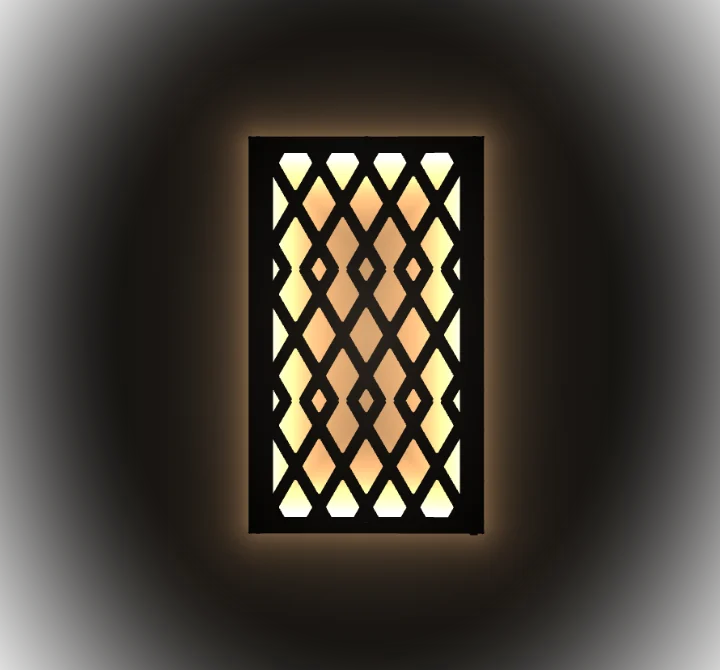
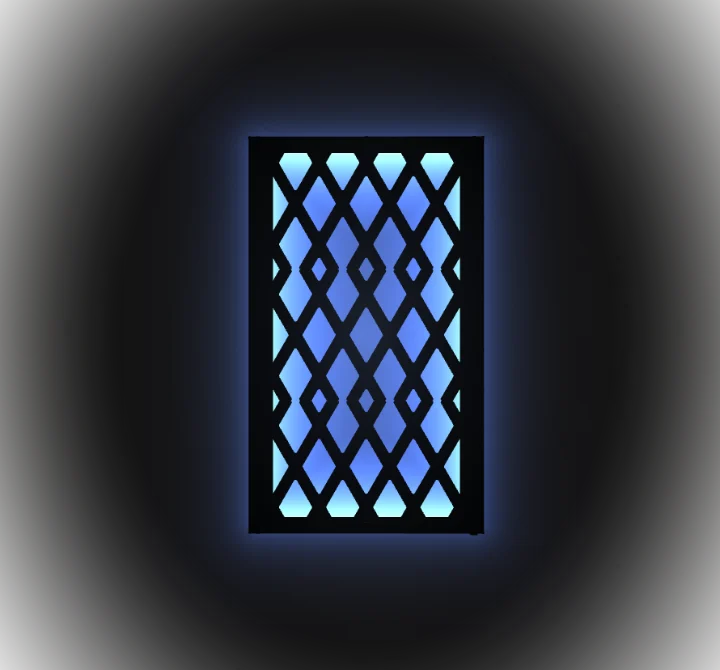
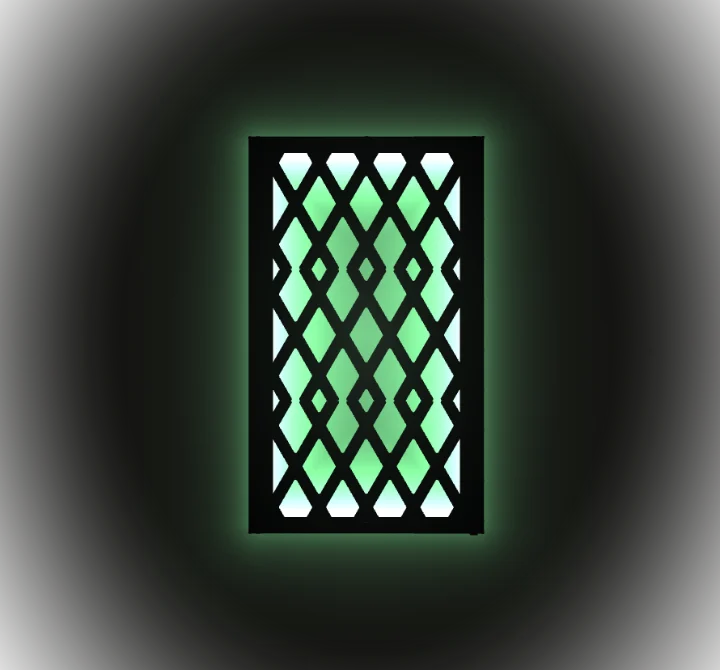
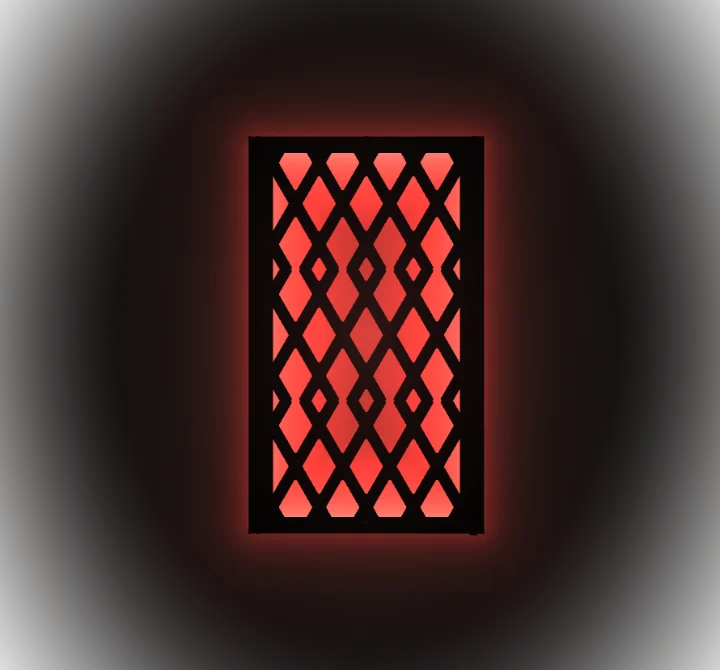
The Trelace Frame lit from within on a stucco wall beside a desert pool at night

Trelace · The Frame Launching Q1 2027

The Trelace Frame

A laser-cut screen in a powder-coated aluminum frame, with light built in and room to grow.

Illustrative rendering

About, wide by tall · 35 × 59 × 4 in.
3 × 5ft
IP67 light, warm white every night
RGBW+ 2700K
Planters and accessories
450lb
Engineered for wind gusts
115mph

Load and wind figures apply when installed to spec on block walls with all eight anchors.

Design

Make it yours.

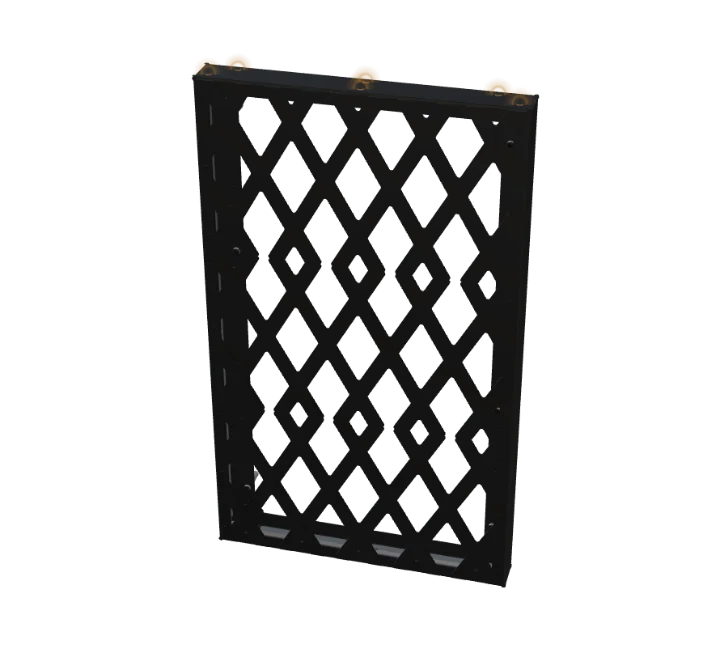
One panel, edge to edge, for an uninterrupted pattern. Or three stacked panels, mixed however you like, each screwed on through the face. Either way, one face can replace another while the frame stays on the wall.

Illustrative rendering. Patterns other than the diamond lattice are early designs, not yet available.
Screen
Panel
Pattern for the middle panel
Back sheet

Back sheet off: your wall shows through and becomes part of the piece.

Light

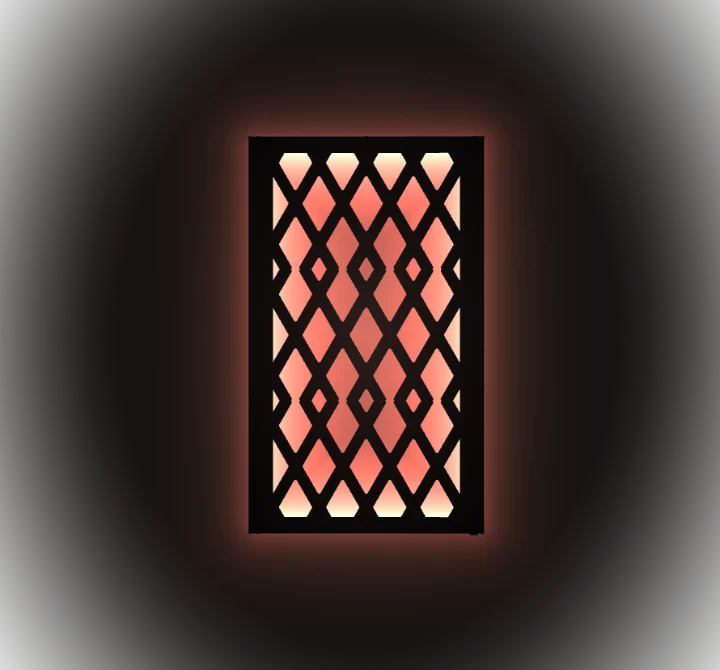
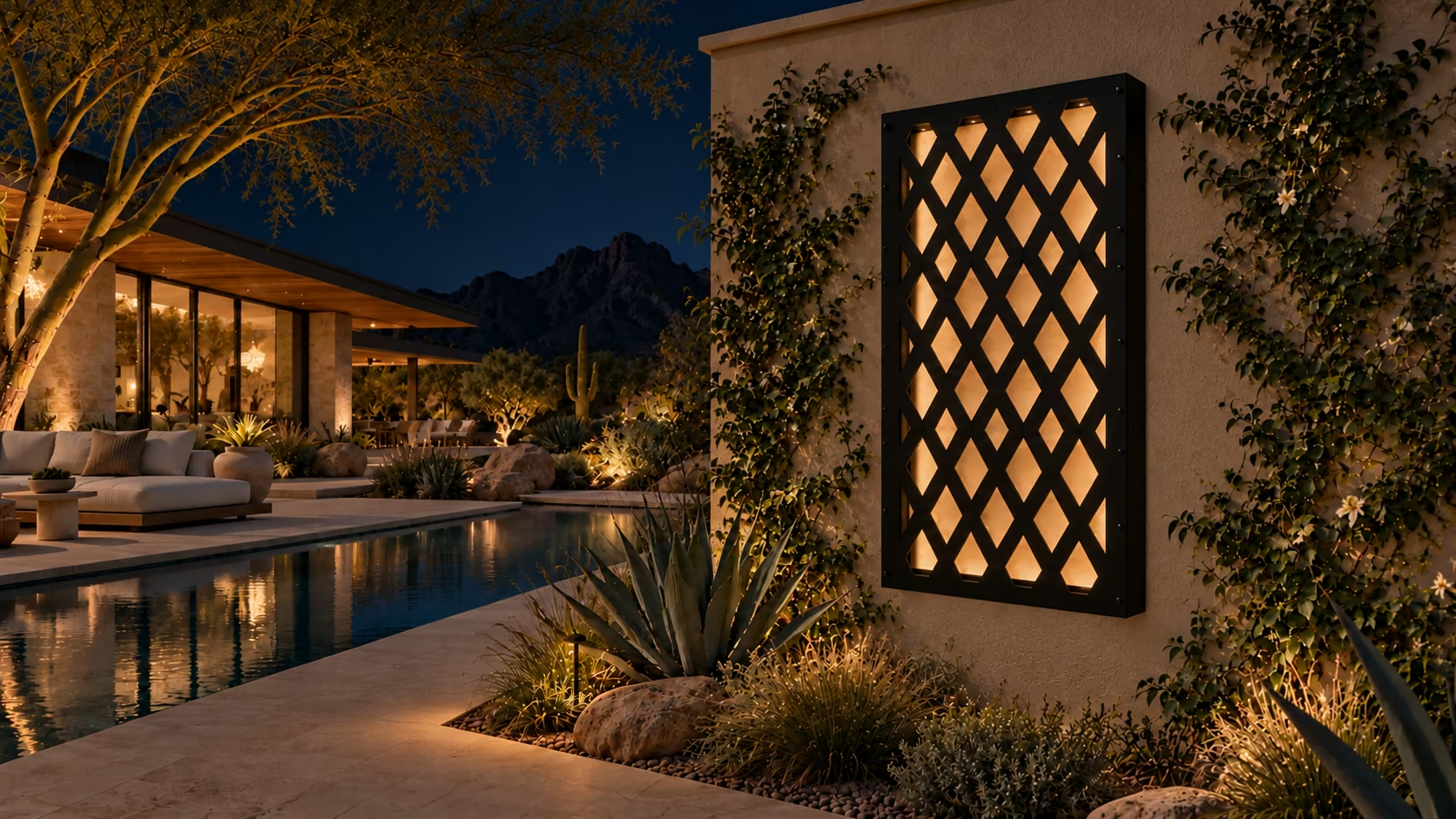
Lit from within.

The Trelace Frame after dark, its light strip washing the wall behind the pattern in warm white.
Rendered from our engineering CAD

A commercial-grade RGBW strip, IP67 rated, runs inside the frame and washes the wall behind the pattern. After dark the wall glows and the pattern reads in silhouette: 2700K warm white every night, full color when you want it, from a 24 V DC driver and RGBW controller (available separately). The strip can be replaced without taking the frame off the wall.

Color and white
RGBW
Rated for outdoors
IP67
Warm white channel
2700K

Engineering

Built for the desert.

How it is made, how it mounts and how it holds up in monsoon season. Rendered from our engineering CAD, simplified for the web.

See the simulations and how to compare any screen

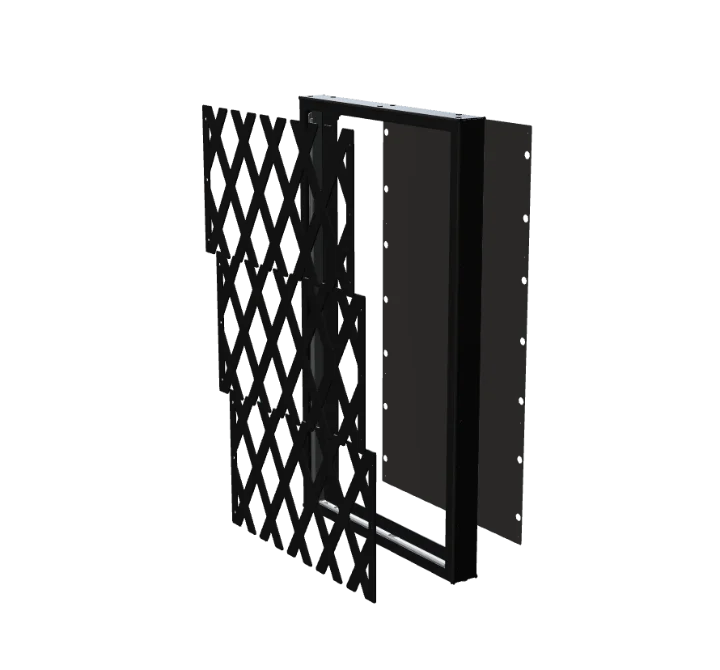
  1. The frame pulled apart into its three layers: the optional back sheet, the frame and the screens.

    Three layers

    Laser-cut screens in front (one full-height panel or three stacked), a powder-coated aluminum frame with the light concealed inside, and an optional back sheet behind.

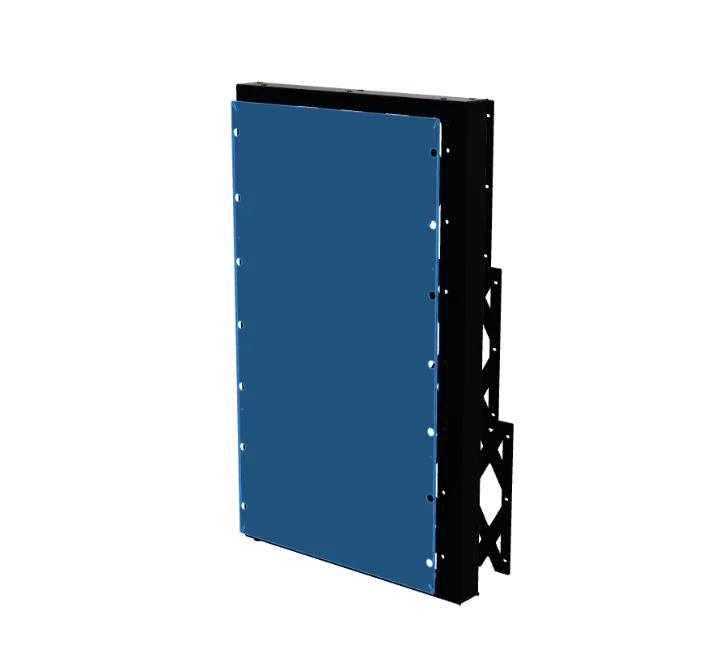
  2. The frame from behind, with the optional back sheet highlighted.
    Back sheet shown highlighted · ships black

    Optional back sheet

    A black sheet behind the screens gives a sharper, more graphic look. Leave it off and your wall becomes part of the piece.

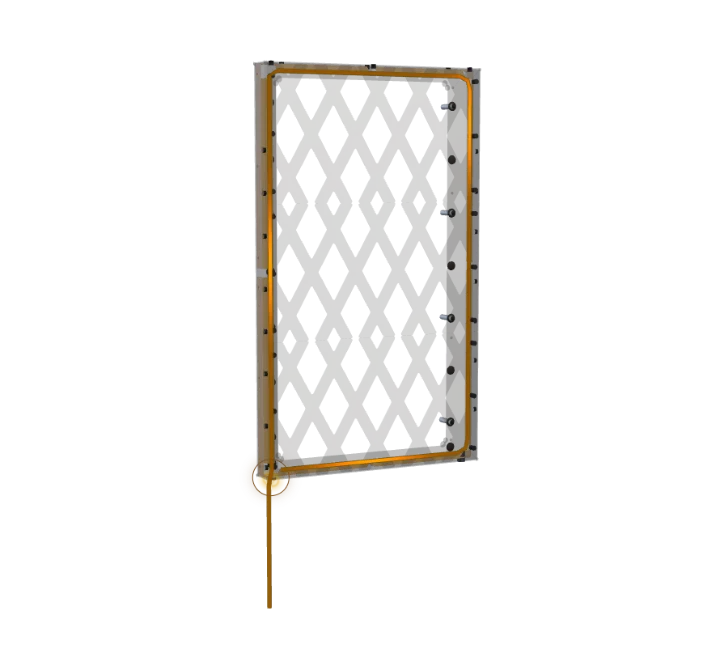
  3. The wiring channel shown in amber: low-voltage power enters at the bottom-left corner and runs around the frame to the edge lighting.

    Wiring channel

    A protected path for the low-voltage power that runs the edge lighting. It enters at the bottom of the frame, with room for accessories to come.

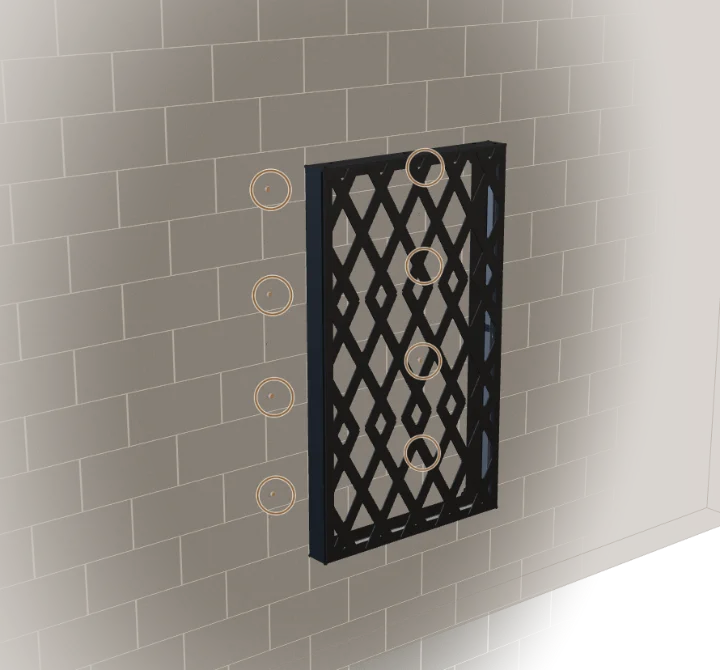
  4. The frame lifted off the wall to show the eight wall anchors.

    Eight wall anchors

    Anchored to your block wall at eight points by a trade installer.

    anchors into the wall
    8
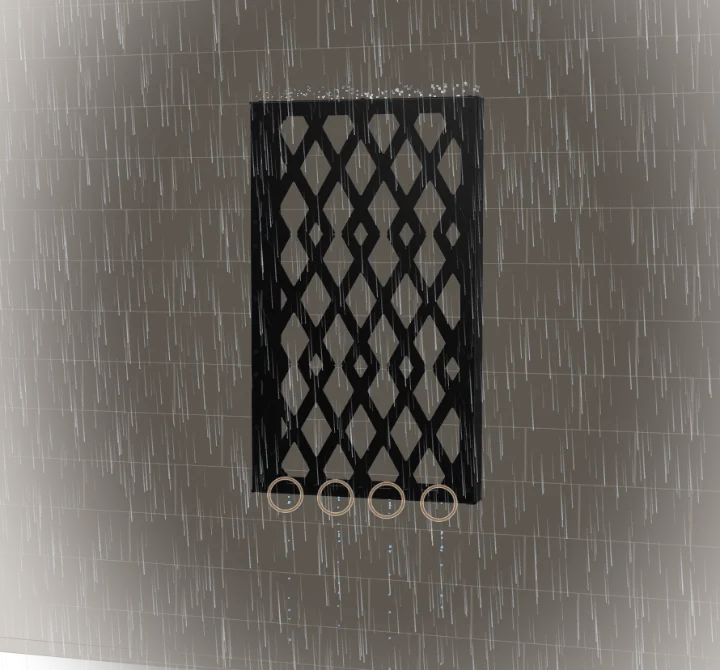
  5. The anchored frame in a monsoon storm, wind-driven rain around it and water draining from the four weep holes along its bottom edge.

    Built for monsoon season

    Engineered for 450 lb of planters and accessories and wind gusts up to 115 mph when installed to spec on block walls with all eight anchors. Four weep holes along the bottom edge drain the rain.

    planters and accessories
    450lb
    wind gusts
    115mph
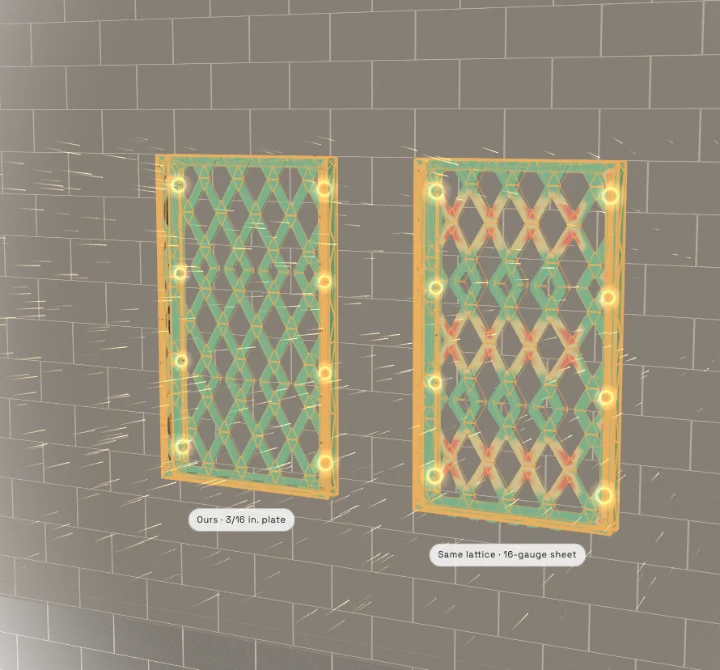
  6. Two frames on a block wall in an analysis view of the 115 mph wind case, each screen held by its six screws: ours with 3/16 in. plate screens, barely moving and green, a little warmer at the screws, and beside it the same lattice in 16-gauge sheet, bowed out toward the viewer and red at its screws and at a few lattice joints where the stress passes the alloy's yield; a fine amber mesh over both, wind streaming across them, the anchors marked, and a green-to-red legend that runs to yield.
    115 mph wind · 3/16 in. plate beside 16-gauge · color: stress

    Checked before it ships

    Phoenix heat and monsoon gusts set the spec, so the design is analyzed under full load in our CAD before any frame ships. Here, a 115 mph gust on our 3/16 in. plate screens and on 16-gauge sheet; red is past the alloy's limit.

Built to grow

The first piece. Not the last.

Every frame ships with the mounting points, the water line and the low-voltage channel it will need later. The steps below show where they sit.

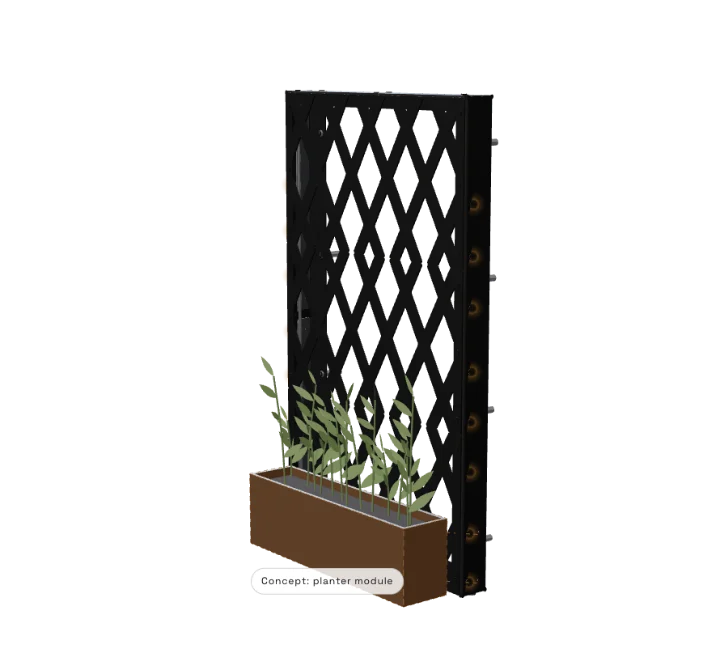
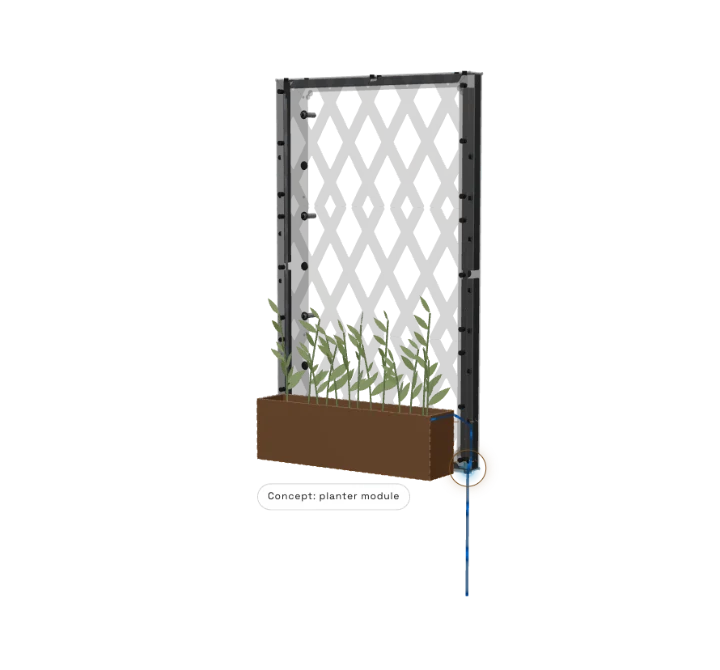
  1. The side mounting points highlighted, with a concept planter module hanging from two points on each side.

    Side mounting points

    Threaded stainless points along both sides, ready for modules that hang in front of the screen. A planter module takes two on each side.

    points, eight per side
    16
  2. The frame shown see-through: water rises into the quick-connect at the base and runs up the right side of the frame to the planter.

    Irrigation connection

    A quick-connect at the base takes the drip line. Planter modules, now in development, bring their own tubing, which runs up the side of the frame to up to three planters.

  3. The six mounting points in the top edge of the frame highlighted.

    Top mounting points

    Six points in the top edge, built in from day one.

    points in the top edge
    6
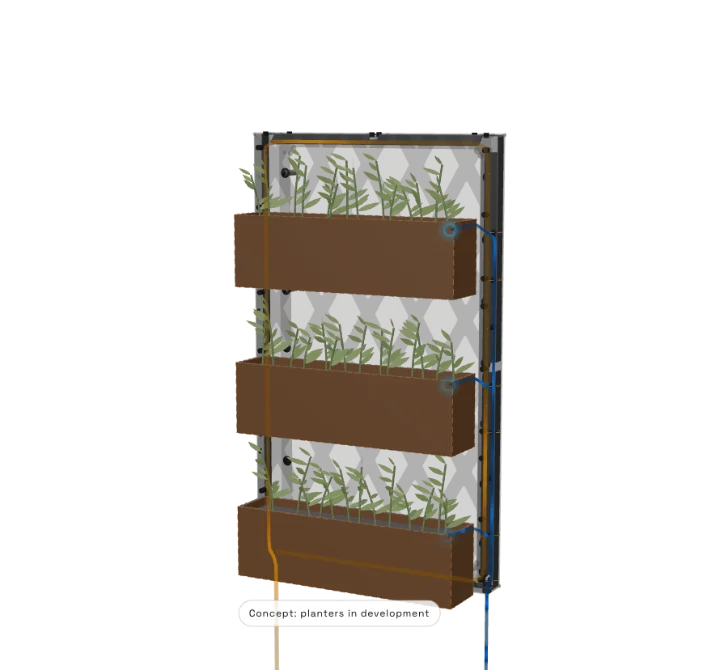
  4. The finished frame shown see-through with three concept planter modules on the side mounting points: water runs from the base up the right side into each planter, and amber low-voltage power runs the channel to the edge lighting.

    Built in from day one

    Water and power are already inside: a quick-connect at the base waters up to three planter modules, now in development, and a low-voltage channel powers the edge lighting, with room for accessories to come. The side mounting points are engineered to carry all three, wet soil and all.

Size and specs

The details.

About 3 ft (35 in.)About 5 ft (59 in.)About 4 in.FrontSide5 ft 9 in
Shown beside a 5 ft 9 in person for scale, with the three-panel seams. Sizes are approximate; dimensioned drawings come with the Trade Kit.

Size and materials

Frame size
About 3 ft wide by 5 ft tall (35 × 59 in.), 4 in. deep
Weight
About 47 lb with three panels, about 55 lb with the optional back sheet, before planters
Material
Powder-coated aluminum
Screen
One full-height panel or three stacked panels
Faces
Interchangeable; the three panels screw on through the face
Back sheet
Optional, black
Origin
Designed and engineered in Phoenix; laser-cut, powder-coated and assembled in Arizona; aluminum and hardware from US suppliers

Light

Lighting
Commercial-grade RGBW LED strip (IP67, 24 V DC) with a 2700K warm white channel, concealed in the frame
Power
24 V DC. Runs from a 24 V DC driver and RGBW controller (available separately); most landscape lighting transformers are 12 to 15 V AC, so the installer adds the driver
Service
LED strip replaceable without taking the frame off the wall

Mounting and engineering

Mounting
Anchored to the wall at eight points by a trade installer
Load and wind
Engineered for 450 lb of planters and accessories and wind gusts up to 115 mph when installed to spec on block walls with all eight anchors (ASCE 7 wind calculation and SolidWorks modeling, reviewed by a licensed Arizona professional engineer)
Drainage
Four weep holes along the bottom edge

Built to grow

Mounting points
Sixteen on the sides and six on top
Wiring channel
Protected low-voltage path to the edge lighting, entering at the bottom, with room for accessories to come
Irrigation
Quick-connect at the base for up to three planter modules (in development), whose tubing runs up the side of the frame
Planter capacity
Engineered for three planter modules at full wet-soil weight, each on two side points per side

Support

Price
$4,950 list for the lit Frame with your choice of screen from our pattern series. Installation by a trade partner, the 24 V DC driver and the RGBW controller are priced separately
Lead time
Confirmed with each order
Warranty
Details at launch
Download the preliminary overview (PDF)

Preliminary. Specifications may change before launch. Dimensioned drawings come with the Trade Kit. Get the Trade Kit

Installation

How it gets on your wall.

  1. Choose the face

    One full-height panel or three stacked panels, a pattern for each, and the back sheet on or off.

  2. Check your approvals

    HOA and design review approvals are the property owner's responsibility. We help with the drawings and details reviewers ask for.

    How approvals work
  3. Installed by the trade

    A trade installer anchors the frame to your block wall at eight points and connects the light to a 24 V DC driver and RGBW controller.

FAQ

Frequently asked questions

What does it cost?
$4,950 list for the lit Frame with your choice of screen from our pattern series. Installation by a trade partner, the 24 V DC driver and the RGBW controller are priced separately, and Signature patterns are quoted per design. Founding installs get the first install slots and a design consult on their pattern.
Can I change the pattern later?
Yes. A new face can replace the old one while the frame stays on the wall, and the three stacked panels screw on through the face, so you can change one at a time.
What is it made of?
A powder-coated aluminum frame with laser-cut screens and integrated LED lighting concealed in the frame.
One panel or three?
Either. One full-height screen runs the pattern edge to edge. Three stacked panels are each held with screws, so you can mix patterns or change one panel at a time while the frame stays on the wall.
Where is it made?
It is designed and engineered in Phoenix. The screens are laser-cut, the frame is powder-coated and each unit is assembled in Arizona, with aluminum and hardware from US suppliers.
Can it hold planters?
Yes, it is built for them. Up to three planter modules, now in development, hang on the side mounting points, two on each side, and the frame is engineered to carry all three at full wet-soil weight. A quick-connect at the base waters each one, through tubing that runs up the side of the frame.
How does it hold up in monsoon season?
It is engineered for 450 lb of planters and accessories and wind gusts up to 115 mph when installed to spec on block walls with all eight anchors, based on ASCE 7 wind calculations and SolidWorks modeling reviewed by a licensed Arizona professional engineer. Your installer confirms your wall can carry it. Four weep holes along the bottom edge drain the rain.
What kind of lighting does it have?
A commercial-grade RGBW LED strip, IP67 rated for outdoor use, runs inside the frame and washes the wall behind the pattern. It has a 2700K warm white channel for everyday light and full color when you want it, and it runs on 24 V DC from a driver and RGBW controller (available separately). The strip can be replaced without taking the frame off the wall.

Next

Two ways in.

For the trade

Specify it. Install it. Come back for what's next.

Specs, engineering drawings, warranty and trade pricing for landscape contractors, landscape architects, and designers.

Get the Trade Kit
For Phoenix homeowners

Be one of the first walls in Phoenix.

We are choosing a small number of Phoenix homes for the first installs in Q1 2027, each with a design consult on its pattern.

Become a founding install